Cry Tracker
Log a cry in one tap — size, mood, triggers — and turn it into mood breakdowns, size distributions, and streaks.
Problem
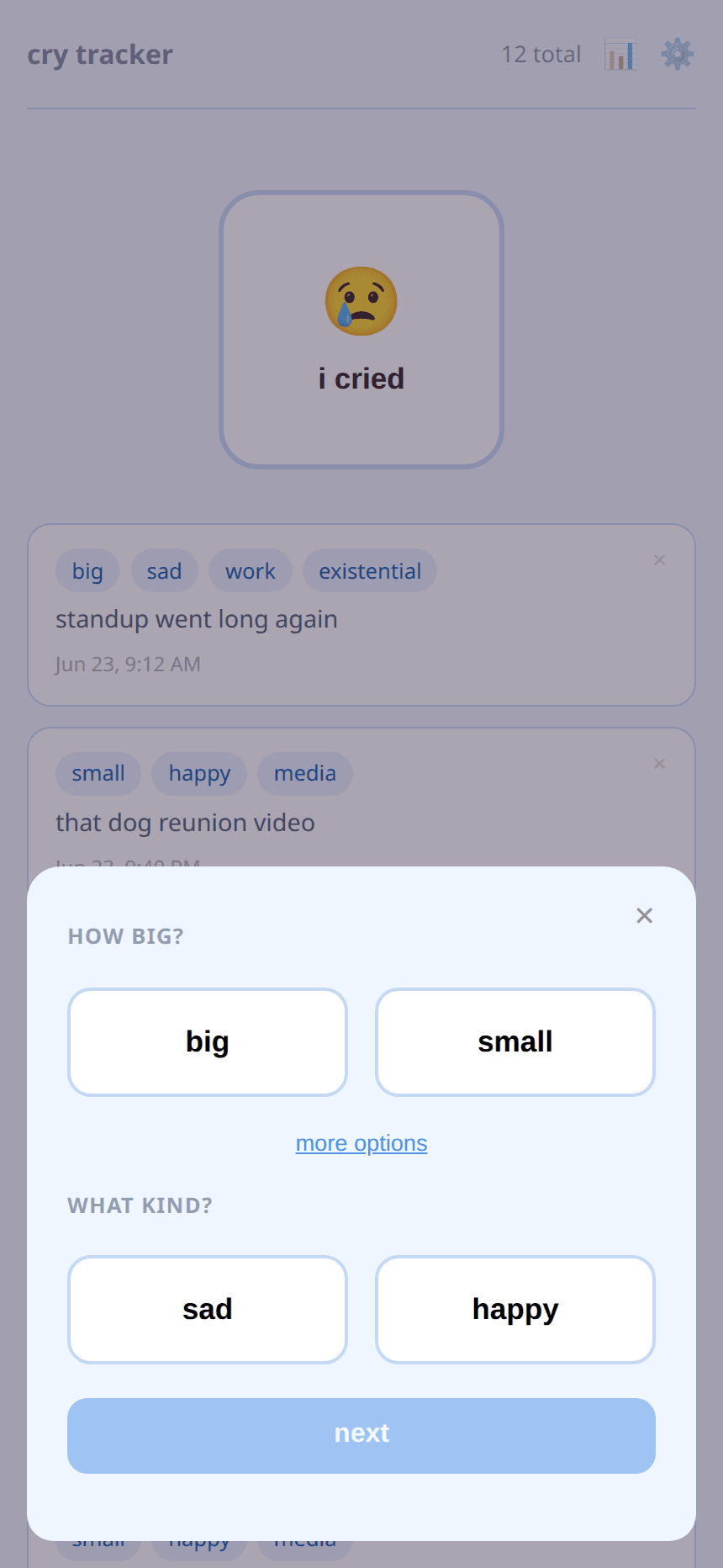
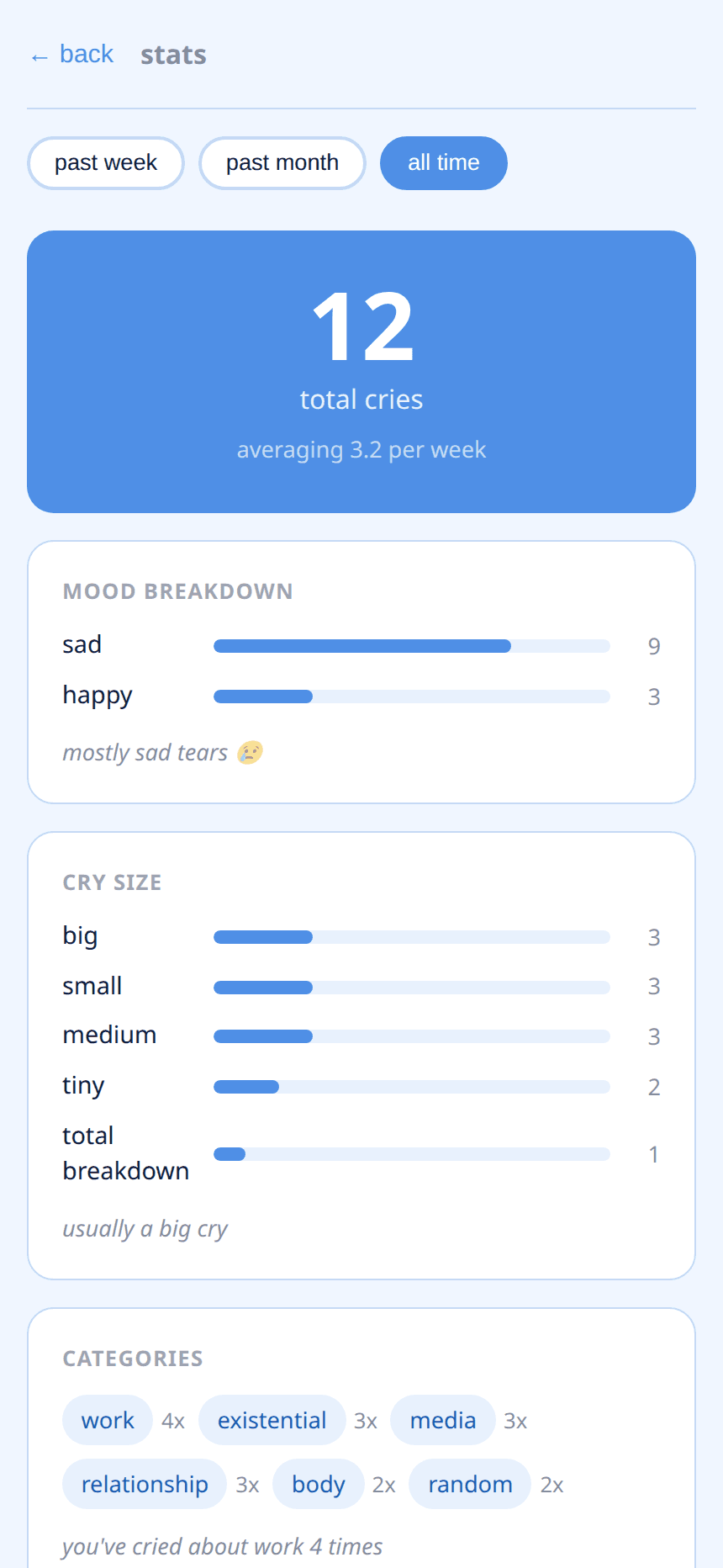
I wanted a small personal tracker: one tap to log a cry, then enough structure to see a pattern. How big was it, happy or sad, what set it off, an occasional note. The data entry was never the point — the payoff was the mood breakdown, the size distribution, the recurring triggers, the streak.
It only ever needs to serve one person. So the real constraint was keeping it
tiny and cheap to run, while still being a real app — authenticated,
persistent, deployed — not a toy stuck in localStorage.
Approach
An npm-workspaces monorepo, two halves: a Svelte 5 SPA for the UI, a Hono API on Cloudflare Workers backed by Cloudflare D1 for everything else. The SPA ships as a static bundle. All state lives in D1 behind the Worker; the browser only keeps a bearer token.
- PIN gate, not accounts. One user means auth can just be a numeric PIN,
exchanged for a session token, rate-limited per IP (5 attempts / 15 min) via
an
auth_attemptstable. The PIN lives in a Worker secret, never in committed source — tests use their own fixed test-only PIN. - Data the app can reshape. Sizes, valences, triggers — the selectable
labels aren't hardcoded enums. They live in a
configtable, editable in Settings. The app's vocabulary is data. - Stats as the product. The cries table is flat, no foreign keys, on purpose — it keeps the aggregation queries (mood split, size distribution, trigger frequency, streaks) simple and fast.
Result
A complete, deployed app that does one thing well and costs almost nothing to
run: a static Svelte front end, a Hono Worker on Cloudflare's free tier. The API
is small and fully covered by integration tests against a real Workers runtime
(@cloudflare/vitest-pool-workers) — auth, the cries CRUD flow, config. Auth is
rate-limited, secrets stay out of the repo, and the label lists are editable —
so it tracks crying the way I actually think about it, not some predefined
taxonomy.